With email, you decide who sees your message, and your reach stays steady no matter how platforms change. So why do so many campaigns still fall flat? The message, the audience, and the timing aren’t lined up. The best campaigns send one focused message to the right person at the right moment.
This guide covers what sets high-performing campaigns apart, the 8 most effective campaign types, and a 6-step process for building your own. With monday campaigns, you can bring audience intelligence and connected CRM data into every send.
Key takeaways
- Match your message to the moment: send the right email to the right audience segment, with one focused action. That’s what separates campaigns that convert from ones that get ignored.
- Design for phones, measure for revenue: mobile-first layouts and business-tied metrics (purchases, renewals, demos) matter far more than open rates alone.
- Automate based on behavior, not a calendar: trigger emails from real customer actions, like signups, purchases, or inactivity, so every send feels timely and relevant.
- Build campaigns faster with monday campaigns: use AI-generated audience suggestions, live CRM data, and drag-and-drop email building to go from brief to send without switching platforms.
- Test one thing at a time, then iterate: changing one variable per send is the fastest way to understand what’s working and keep improving results.
What makes an email marketing campaign one of the best?
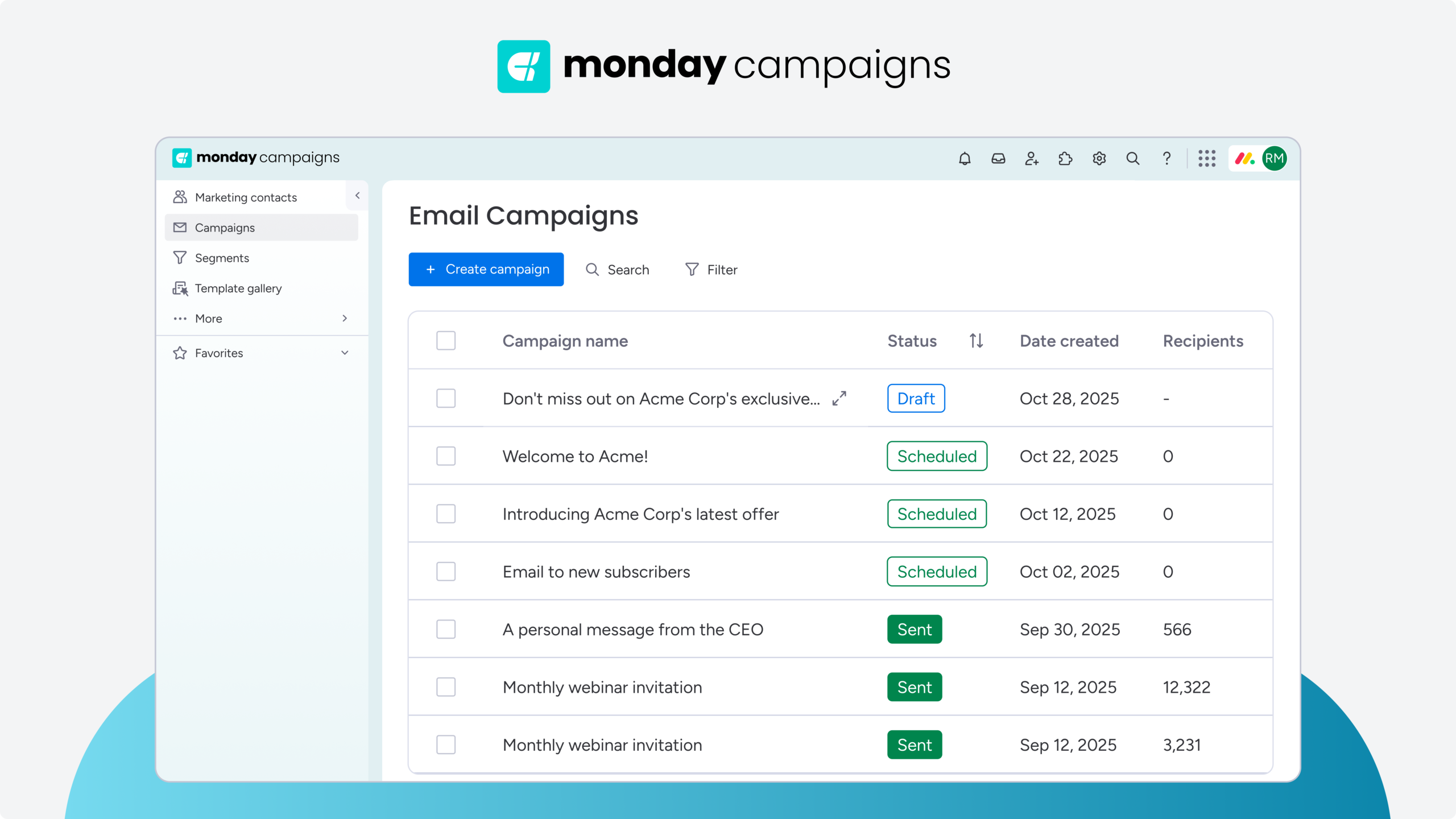
Strong email campaigns share a common foundation: they match the message to the audience, arrive at the right moment, and ask the reader to take one clear action. These campaigns move real business goals forward, not just open rates.
When choosing where to focus, start with the campaign type that matches the customer moment. What action do you want the reader to take right now?
| Campaign type | Primary goal | Typical trigger |
|---|---|---|
| Welcome and onboarding | Activate new subscribers | Signup or first purchase |
| Newsletter | Build ongoing engagement | Scheduled cadence |
| Promotional | Drive purchases or upgrades | Offer window |
| Product launch | Generate awareness and adoption | New release |
| Re-engagement | Recover inactive contacts | Inactivity threshold |
| Post-purchase | Increase retention | Transaction completion |
| Survey and feedback | Gather customer insight | Milestone or interaction |
| Event invitation | Drive registrations | Upcoming event |
An email marketing campaign is a planned send (or sequence of sends) built around one measurable action. That action could be starting a trial, claiming an offer, attending an event, or renewing a subscription.
5 traits that define successful email campaigns
Here’s what separates campaigns that convert from campaigns that get ignored. They feel relevant, read well on any device, and push toward one action that matters.
| Criterion | What it looks like |
|---|---|
| Relevance | Segmentation and personalization that fit the reader |
| Design | Mobile-first layout and accessible formatting |
| Focus | One main CTA, not competing asks |
| Impact | Tied to pipeline, revenue, or retention |
| Automation | Timely sends powered by triggers and AI support |
Trait 1: Relevance starts with segmentation and personalization
Segmentation decides who gets the email. Personalization shapes what they see. A great message sent to the wrong group still flops. According to McKinsey’s 2026 Global B2B Pulse, more than 90% of organizations now personalize content across email, websites, social media, and e-commerce, making segmentation and personalization a baseline expectation, not a differentiator. Here’s how those two levers work in practice:
- New signup segment: Receives a welcome email within 24 hours.
- Recent buyer segment: Receives a product-specific follow-up.
- Inactive subscriber segment: Receives a win-back email after 60 or 90 days.
- Event registrant segment: Receives reminders, while non-registrants receive invites.
Dynamic segments tied to your CRM update automatically when contacts change lifecycle stages. When a free trial user converts to a paying customer, they exit prospect nurture campaigns and enter customer onboarding sequences. Lists stay current automatically, freeing your team to focus on strategy. Want to go deeper? Explore these email segmentation strategies for more ways to group your audience.
Trait 2: Design should work on phones first
Most readers open emails on their phone before they ever see them on a laptop. If the email’s hard to scan, hard to tap, or image-dependent, engagement drops fast. A mobile-first layout usually includes:
- Short paragraphs: Easy to skim in seconds.
- Single-column design: Easier to read on smaller screens.
- Large buttons: Easy to tap without zooming.
- Readable text: At least 14px body copy.
- Alt text: Helpful when images do not load.
Dark mode also matters. Logos, text overlays, and button colors should still look intentional when inbox apps shift the background. For layout inspiration, browse these email marketing templates that follow mobile-first best practices.
Trait 3: One CTA usually wins
The strongest emails ask for one action and support it from subject line to button text. When every element points to the same next step, the reader knows exactly what to do. monday campaigns helps you keep that focus by pulling audience and CRM context into the send, so your message and your ask stay aligned.
Weak campaigns usually have too many buttons, mismatched copy, and a landing page that goes in a different direction. High-performing sends stay focused.
Trait 4: Impact matters more than vanity metrics
Open rate and click rate tell you if someone noticed the email. To understand whether a campaign moved the business forward, you need to look beyond those signals. The metrics that matter most depend on the campaign goal:
- Promotions: purchases or upgrades.
- Event emails: registrations and attendance.
- Welcome flows: first meaningful action.
- Lifecycle emails: renewals, reorders, or retained revenue.
- B2B campaigns: demo requests and influenced opportunities.
CRM-connected reporting gives marketers a fuller view by showing campaign engagement alongside customer and sales movement in one unified view. In fact, Capterra’s 2026 Sales and Marketing Software Trends report found that email is ranked the most important CRM channel by 29% of organizations, ahead of social media and digital ads. To see how these numbers play out, check the email marketing metrics worth tracking.
Trait 5: AI and automation help with timing
Lifecycle automation sends emails based on customer actions, not just a calendar. Someone signs up, receives a welcome email. Someone goes inactive, enters a win-back flow. That timing feels far more relevant.
AI can help draft copy, suggest an audience, or recommend when to send. AI-generated campaigns can use sales insights, CRM data, and external context to shape a more relevant send. Learn more about email marketing automation and how to set up triggers that fit your customer journey.
Try monday campaigns8 main types of email marketing campaigns to know
Before you borrow an idea, it helps to know what kind of campaign you’re actually building. Are you trying to activate someone? Convert them? Retain them? Or win them back? The table below maps each campaign type to its goal and the CTA most likely to drive action.
| Campaign type | When it's sent | Main goal | Best CTA |
|---|---|---|---|
| Welcome and onboarding | After signup or purchase | Activate | "Get started" |
| Newsletter | Weekly or monthly | Engage | "Read more" |
| Promotional | During an offer window | Convert | "Shop now" |
| Product launch | At release | Drive adoption | "See what's new" |
| Re-engagement | After inactivity | Win back | "Come back" |
| Post-purchase | After transaction | Retain | "Reorder now" |
| Survey and feedback | After a milestone | Collect insight | "Take the survey" |
| Event invitation | Before an event | Register | "Save your spot" |
Start with welcome emails if you are building your first campaign. They set the tone for everything that follows.
Campaign type 1: Welcome and onboarding campaigns
Welcome emails work because attention’s highest right after signup. The reader expects to hear from you. That makes this one of the easiest moments to waste or win. Keep the structure simple:
- Subject line: Sets the expectation immediately.
- Warm greeting: Acknowledges the new relationship.
- Value promise: Tells the reader what they get.
- One next step: Removes any guesswork.
- Support option: Gives them somewhere to go if they need help.
Standout examples include Notion with short copy, one next step, and direct product entry. Headspace uses small, encouraging steps spread across a sequence.
Campaign type 2: Newsletter campaigns
Newsletters build trust over time. They’re less about immediate conversion and more about staying useful enough that readers keep opening. A solid newsletter usually includes:
- An opening hook explaining why this issue matters.
- 3–5 short content blocks with headlines.
- One primary CTA for the issue.
Morning Brew uses a repeatable format with punchy writing and easy scanning. Shopify leads with education first, product mentions second.
Campaign type 3: Promotional campaigns
Promotional emails push for direct action, so the offer needs to appear fast. The reader should understand the value in seconds, not halfway through the scroll. When building this campaign:
- Place the offer first.
- Explain why it matters now.
- Use a single CTA.
- Exclude recent buyers from discount campaigns to avoid frustrating customers who just paid full price.
Everlane places the sale message at the top with visible pricing and one main button. Grammarly uses usage-based upgrade messages tied to real customer moments.
Campaign type 4: Product launch campaigns
Launch emails announce what’s new and why it matters. Get straight to the update with a concise, benefit-focused message. A three-email launch structure works well:
- Teaser email: sent 1–2 weeks before launch to build anticipation.
- Launch-day email: sent at release with the full announcement.
- Follow-up email: sent 3–5 days later to educate and expand.
Figma uses feature name, simple explanation, and visual demo. Apple focuses on strong visuals, short benefit lists, and direct product action.
Campaign type 5: Re-engagement and win-back campaigns
Win-back emails protect revenue and list health. A three-email win-back sequence usually looks like this:
- First email: acknowledges the gap and opens the door.
- Second email: reminds them of the value they are missing.
- Final email: asks whether they still want to hear from you.
Duolingo uses playful reminders with low-pressure asks and one action. Spotify reminds former subscribers what they are missing, then presents a return offer.
Campaign type 6: Post-purchase and lifecycle campaigns
Post-purchase emails reassure customers and help them get value from their purchase. Lifecycle emails take that same approach and apply it to renewals, replenishment, and repeat purchases. The best lifecycle emails follow the customer journey, not an arbitrary schedule. Deloitte’s 2026 Omnichannel Post-Purchase study found that 78% of consumers would be more likely to choose a company that shows a specific delivery date at checkout, while nearly 20% already feel they receive too many notifications, reinforcing that relevance and timing matter more than volume.
Warby Parker combines confirmation with useful onboarding tips. Dollar Shave Club times reorder reminders to expected usage.
6 steps to build your own email marketing campaign
Once you know the campaign type, building gets easier. These 6 steps take you from a blank brief to a live, optimized send with the right audience, message, and follow-up logic in place. For a broader look at the full process, see this guide to building an email marketing campaign.
Step 1: Define your goal and audience segment
Start with one goal. Do you want a signup? A purchase? A registration? A reorder? Or a reply? Then match it to one audience segment:
- Welcome email: Goes to new signups.
- Win-back email: Goes to inactive contacts.
- Promotional email: Goes to a segment likely to convert on the offer.
One goal, one segment. That focus carries through every decision that follows.
Step 2: Build your segment from CRM data
Your CRM stores contact and customer information like purchase history, lifecycle stage, and engagement. That data should shape your audience. Useful segment rules include:
- Signed up in the last 7 days.
- Purchased a consumable 30 days ago.
- Inactive for 60 days or more.
- Registered but missed the event.
Step 3: Design your email with drag-and-drop blocks
Keep it simple: header, hero message, supporting content, CTA, footer. A clean layout removes friction and keeps the reader moving. AI can help draft subject lines and copy. Drag-and-drop builders let you assemble the layout visually, code-free.
Step 4: Choose your subject line and send time
Your subject line and preview text should work together. One opens the door, and the other gives the reader a reason to step through it. A strong subject line usually does one of 3 things:
- Welcomes: “Welcome — here’s your first step.”
- Promises value: “3 ways to get more from your trial.”
- Creates urgency: “Last chance: sale ends tonight.”
Need more inspiration? These email subject line examples can help you test new angles.
Step 5: Launch the send and automate follow-up flows
Some emails work as one-time sends. Others belong in a sequence. What happens after they open? What’s the next step once they click? This is where follow-up logic matters. That’s where automation turns a single email into a campaign that keeps working.
Step 6: Track results and optimize every send
Review delivery, open rate, click rate, unsubscribe rate, and most importantly, conversion. Test one variable at a time so you can connect the result to the change. Consistent iteration is what separates campaigns that plateau from campaigns that keep improving.
Try monday campaignsHow to measure email marketing campaign success
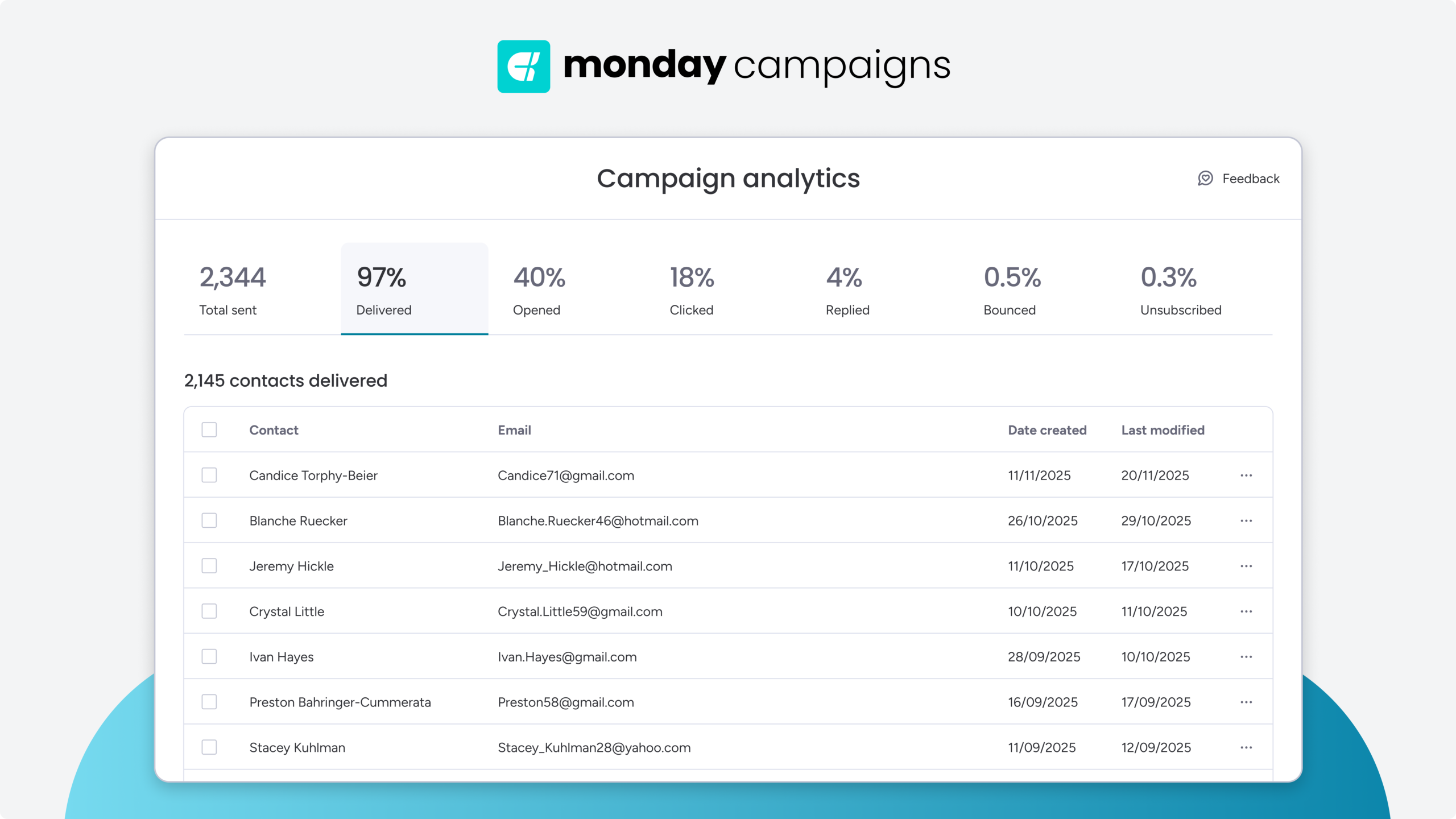
Measurement should match the goal of the campaign. A welcome email shouldn’t be judged the same way as a flash sale or a webinar invite. The three layers below give you a structured way to evaluate any campaign, from first send to long-term impact.
| Metric layer | What to review |
|---|---|
| Revenue impact | Purchases, demo requests, renewals, influenced opportunities |
| Subscriber health | Unsubscribes, spam complaints, inactivity, preference changes |
| Engagement | Opens, clicks, click-through rate, conversions |
Open rate still has value, but business outcomes should lead the conversation. The strongest campaigns are measured by the business action they were designed to drive.
Turn email campaign ideas into revenue with monday campaigns
Great campaign ideas only pay off when your team can launch them quickly. monday campaigns is an AI-powered product in the monday CRM suite that helps marketers create, launch, and optimize campaigns that stay on brand and tied to sales goals. Because it’s built on monday CRM, every send starts with live customer data instead of a stale list.
How do you keep marketing and sales working from the same playbook? With monday campaigns, campaign engagement and customer context sit together on monday.com. Your team can adjust messaging, follow up with the right contacts, and show how email drives pipeline, all in one place.
AI-generated campaigns
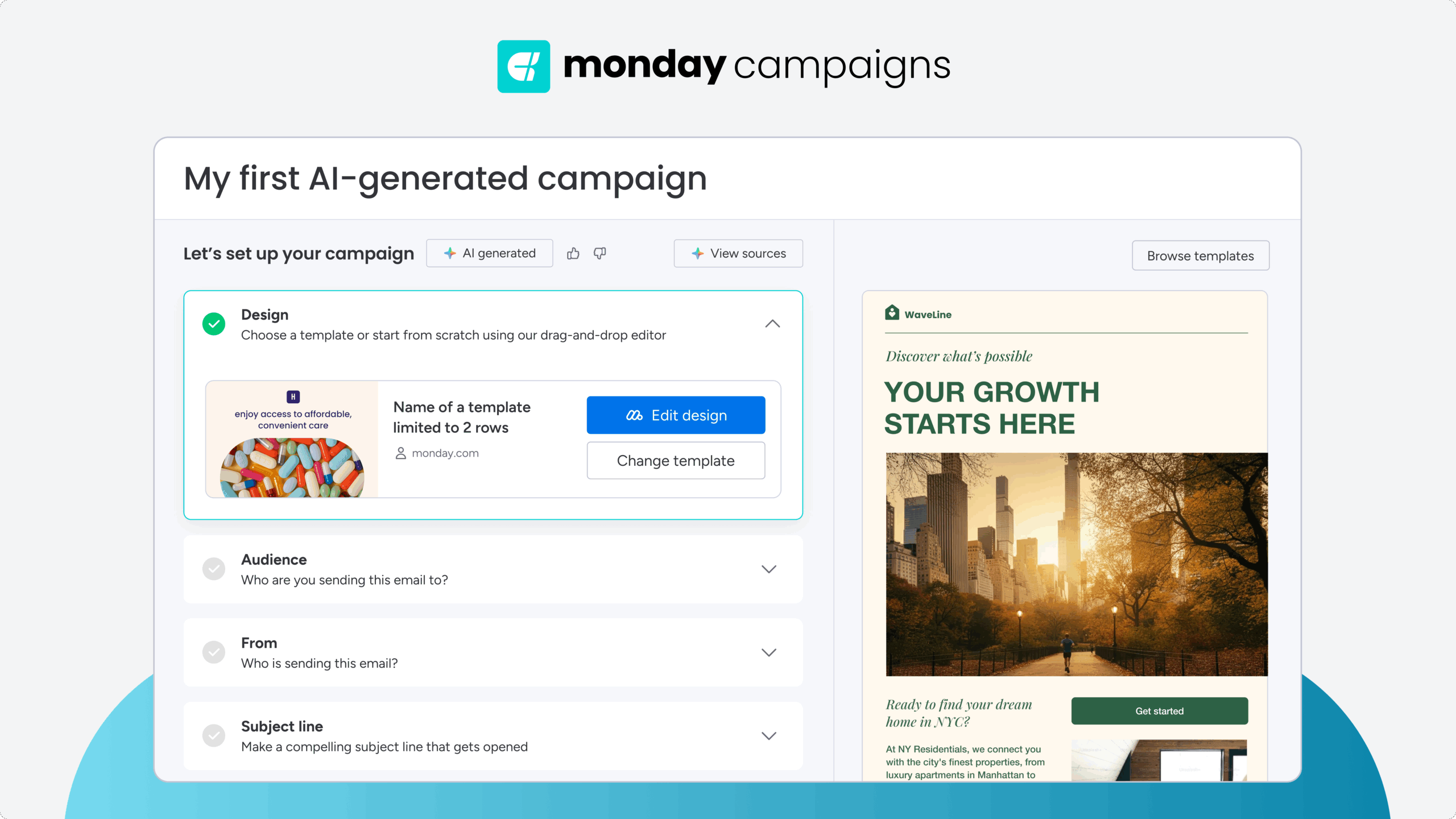
Skip the blank page. AI pulls from sales insights, CRM data, and external context to suggest a campaign that fits your goal, whether that’s a welcome flow or a win-back sequence. It also drafts copy and checks brand consistency, so your team spends more time refining ideas and less time starting from scratch.
AI-suggested audience segments
The right message only works for the right people. AI recommends audience segments based on real customer data, helping you match each campaign type to the contacts most likely to act. Dynamic segments update automatically as contacts change lifecycle stages, so your lists stay current without manual cleanup.
AI send-time recommendations
Timing can make or break a send. monday campaigns uses AI recommendations to suggest when your audience is most likely to engage, so your promotional, launch, and lifecycle emails land at the right moment. You can schedule with confidence and keep every campaign aligned to the customer journey.
Real-time campaign insights
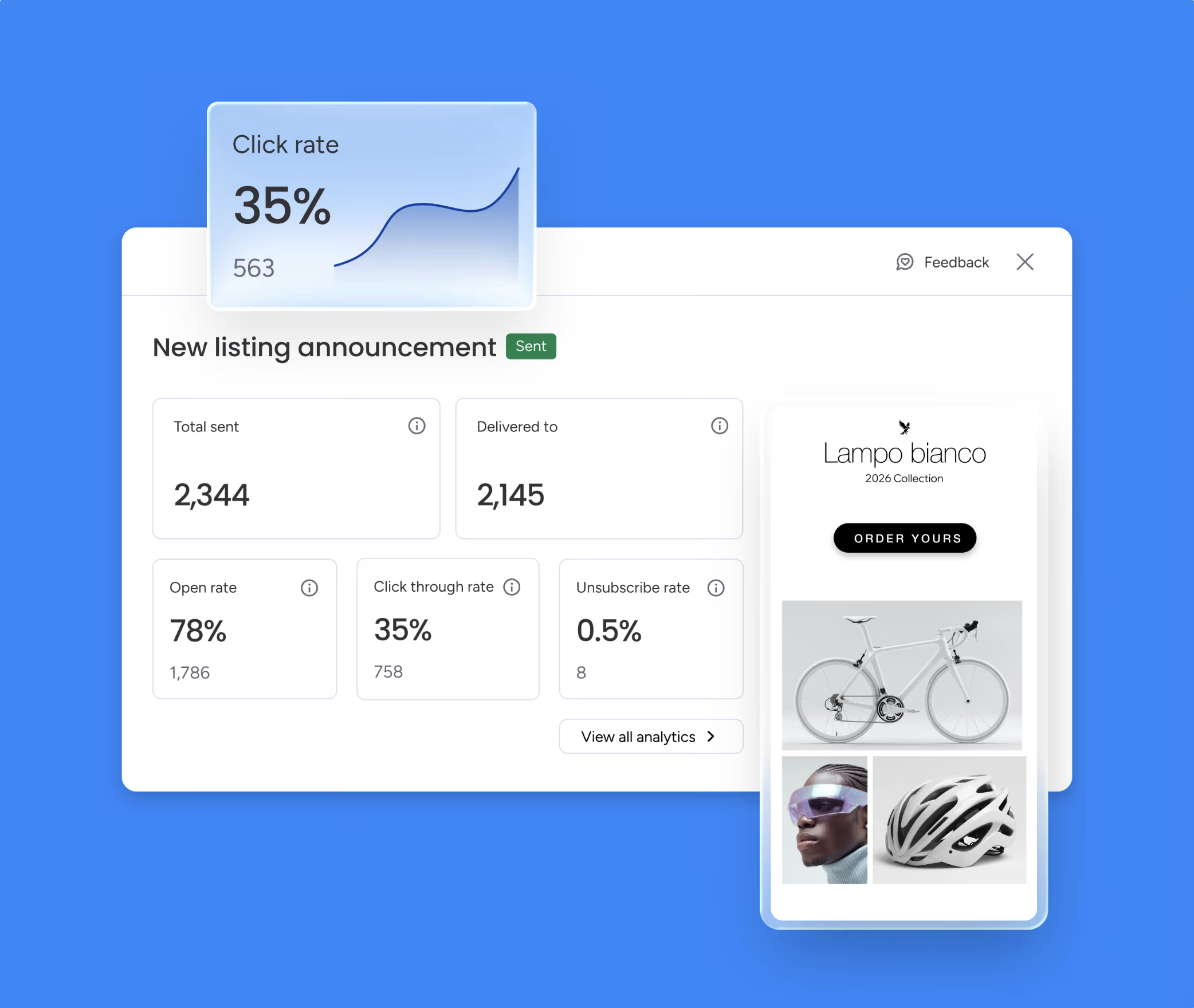
Track recipients, delivered emails, open rate, click rate, and unsubscribes in one view. Because results connect to monday CRM, you can see how engagement moves leads toward demos, renewals, and closed deals. Use those insights to refine your next send, then test one variable at a time to keep improving.
Ready to turn your next campaign into a revenue moment?
Email marketing works when strategy, execution, and measurement come together. The campaigns that drive real results are built around the right audience, one focused action, and a way to track what happens next, not the flashiest design. Getting there takes a direct connection between your customer data, your campaign builder, and your reporting.
That’s where monday campaigns fits in. Whether you’re launching your first welcome flow or optimizing a full lifecycle program, monday campaigns gives you the audience intelligence, AI support, and analytics to build campaigns that move the business forward.
Try monday campaignsFAQs
Is email marketing still worth it?
Is email marketing still worth it? Yes. Email gives you direct access to an audience you own, with no algorithm standing between you and your reader. You can tie every send to measurable actions like purchases, bookings, demo requests, and renewals, which makes it easy to show how campaigns support revenue.
What is the most effective email marketing campaign strategy?
The most effective email marketing campaign strategy matches one message to one audience segment at the right moment. Pair it with one focused CTA and a success metric tied to a business goal, such as purchases or demo requests. With monday campaigns, AI-suggested segments and live CRM data help you keep every send relevant and on target.
What is the 80/20 rule in email marketing?
The 80/20 rule in email marketing means about 80% of your content should deliver value, while 20% promotes an offer or product. Think helpful tips, insights, and resources first, and the ask second. This balance builds trust, keeps readers opening your emails, and makes your promotional sends land with more impact.
How often should you send email marketing campaigns?
How often you should send email marketing campaigns depends on your audience's expectations and the campaign type. Newsletters usually work best on a steady weekly or monthly cadence, while lifecycle emails should follow customer actions like signups, purchases, or inactivity. Track unsubscribes and engagement after each send to find the rhythm your readers prefer.
How do you connect email marketing campaigns to sales results?
You connect email marketing campaigns to sales results by using CRM-linked reporting that ties engagement data to demos, opportunities, renewals, and closed deals. Because monday campaigns is built on monday CRM, campaign performance and customer context sit together in one view. Your marketing and sales teams can then work from the same data and goals.
Can email campaigns be automated based on customer actions?
Yes, email campaigns can be automated based on customer actions through workflow-triggered sends. These sends respond to CRM updates and behavior signals, such as signups, purchases, or periods of inactivity. Every email arrives when it matters most to the reader, and your team saves time on manual scheduling.

 Get started