At Elevate 2026, we took the stage to show how far monday CRM has come — and where it’s going next. Here’s what we shared.

Intuitive AI that works
Looking back at the past year, one thing stands out: monday CRM has become essentially the fastest-growing CRM more or less ever. That growth didn’t come from adding more features to an existing playbook. It came from rethinking what AI in a CRM should actually feel like.
The bar we set: AI that is adoptable, always on, and actually moves the needle. Not AI that sits behind a prompt box waiting to be used. AI that’s already running, already learning, already doing the work — before anyone has to ask. Here’s what hitting that bar actually looks like.
Four agents, built for sales teams
Four purpose-built agents, ready to use from day one — no setup project, no specialist required.
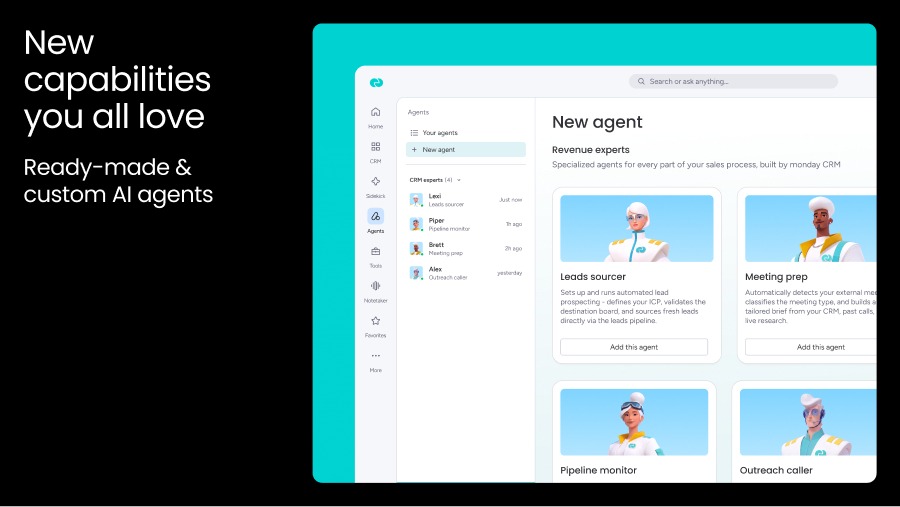
Sources leads, defines your ICP, validates the destination board, and runs automated prospecting directly into your pipeline.
Researches accounts, surfaces risks before they become problems, and handles outbound calls on your behalf — from first intro to follow-up.
Detects your upcoming external meetings, classifies the meeting type, and builds a tailored brief from your CRM, past calls, and live research. Automatically.
Monitors your pipeline health and flags deals that need attention — before you have to ask.
I’ve watched the least tech-savvy people build agents in minutes and produce immense amounts of work. It takes minutes to get them live. That’s the bar we set.
A new home for everything that matters
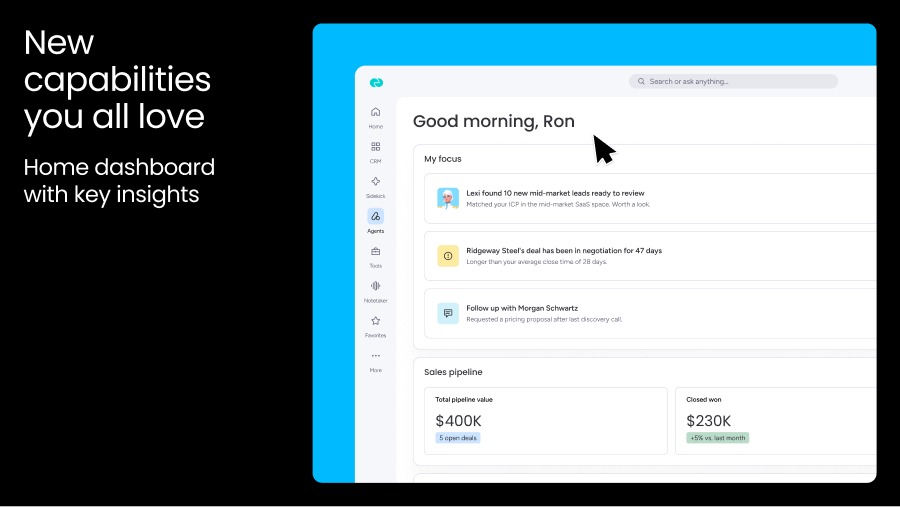
Your agents’ work, your insights, and your business metrics — all in one place. No more hunting through tabs to understand what’s happening in your pipeline. No more context-switching between tools to get a read on the week.
The home is where you check in on what your agents did overnight, see which deals need a nudge, and talk to them directly — right there, without opening anything else. It’s a simple idea: everything that matters about your business, surfaced before you have to go looking for it.
Auto-update your CRM with AI
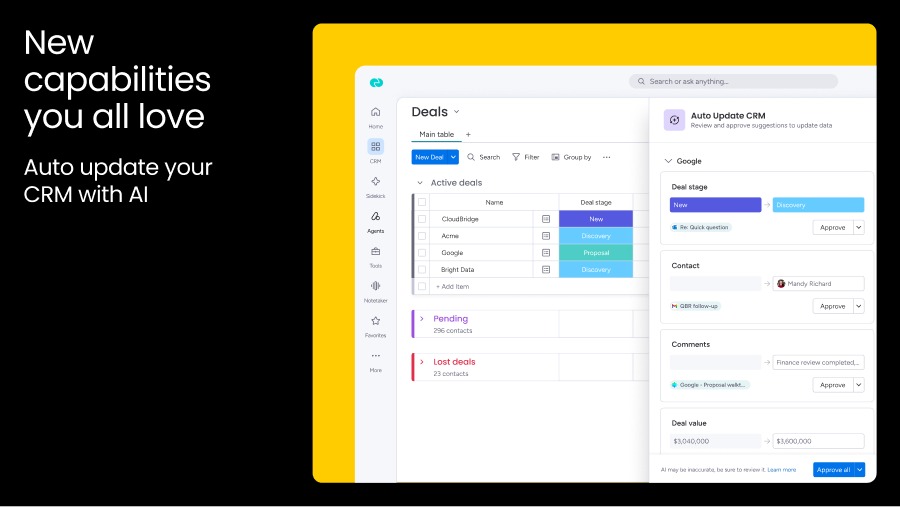
The last thing a rep wants to do after a call is update the CRM. And they usually don’t — which means the data rots, the pipeline goes stale, and the manager is flying blind. Now it’s done for them: every call, email, and meeting is captured, transcribed, and mapped back to the right deal automatically. Fields update. Status changes. The follow-up gets logged. All based on what actually happened, not what someone remembered to type in.
It’s working.

The challenge: more AI isn’t enough on its own
Sales teams today are caught between two painful extremes. On one side: the frozen enterprise suite — expensive, slow to change, requiring a whole team just to keep the lights on. On the other: the fragmented agent pile, where every new tool adds noise instead of removing it.
The real problem is what sits around the AI: the systems, the processes, the data, and whether the people doing the work can actually use it.
We’ve seen this problem before. A few years ago, CRM itself was the hard thing — a long implementation, a dedicated admin, a consultant to change one field. monday CRM was built because that was absurd. The people doing the work should be able to change the tool themselves. Today, AI is the same story all over again. So we did what we did the first time: take the hard part, make it simple, give it to the person doing the job.
Three rules we gave ourselves
We didn’t want to just ship features. Features are easy to ship. What’s hard is knowing whether they’re actually good — good for the rep who has 40 open deals and no time to learn something new, good for the admin who has to maintain it, good for the manager who needs to trust it in a board presentation. So we gave ourselves three rules, and we hold every piece of AI we build to all three.
From “improve me” to “multiply me”
More AI, by itself, does not make a sales team better.
What we’re building is something different. Not tools that improve what a rep does — shave 10 minutes off admin, suggest a reply, summarize a meeting — but tools that multiply what a rep can do. One rep with the right agents behind them can work a pipeline that used to take a team. That’s not an improvement. That’s a different category of tool entirely.
The shift we see unfolding: first came chat tools layered on top of existing software, then AI-native SaaS built around specific tasks, then agents with a human in the loop. What comes next is the agentic platform — where AI doesn’t just assist the rep, it acts on their behalf, learns from every outcome, and gets better the more you use it.
How it works under the hood
Everything starts with your data. Email, calendar, calls, meetings, WhatsApp, campaigns, enrichment — everything connects and lands in one place. Captured, transcribed, understood. Nobody logs anything.
Above that sits the context layer — the company’s brain. It holds four things:
- Process data — how deals move in your specific company
- Domain knowledge — how your team actually sells
- Historical patterns — what’s worked before
- Live signals — what’s happening right now across your accounts
The agents sit on top of the context layer. They do the work, with you in the loop to approve. And every deal feeds back into the context, making the next one smarter.
“Every deal makes the next one smarter.”
The full deal journey: Find → Engage → Win → Expand
Let me walk you through a complete deal lifecycle — following a sales rep named Sarah from an empty pipeline all the way through to a closed deal and account expansion. The point isn’t individual features. It’s the whole thing looks like when it runs together: agents handing off to agents, every step connected, the rep always in control but never bogged down in the work between the work.
When the deal hits a snag — a manager needs to approve a discount, a stakeholder goes quiet — the system notices first. The pipeline agent flags the blocked deal, checks the margin and the competitive context, and surfaces it to the right person with everything they need to decide. The deal moves. The forecast updates. No one had to chase it down.
And after the deal closes, the account team doesn’t start from scratch. They inherit the same record — what was promised, what was negotiated, why the customer bought. Onboarding and delivery happen in the same platform. The whole customer lifecycle, one place.
Throughout all of this: MCP. The AI assistant your company already uses — Claude, Copilot, wherever your team actually works — can connect straight to monday CRM with the same data, the same permissions, just a different front door. No export, nothing custom, everything connected.
What’s coming next
One agent to run them all.
Here’s a first look at what comes next — an agent that connects everything in monday CRM and comes to you proactively, before you even ask. Watch the clip below.
Now build it.
Learn step by step how to build AI agents in monday CRM, so the demo you saw today becomes part of the workflow your team runs.
Join the workshop →